You know that feeling when your car insurance bill lands in your inbox and suddenly you owe $900 you weren’t planning on spending this month? Or when December rolls around and you realize you haven’t saved a dime for holiday gifts? Yeah, we’ve all been there. And it’s the worst.
Here’s the thing — those expenses aren’t actually surprises. You knew your insurance was coming. You knew Christmas was in December (it’s been there every year, promise). The problem isn’t the expense itself. The problem is that you didn’t plan for it.
That’s exactly where sinking funds come in. They’re one of the simplest, most effective tools in personal finance, and once you start using them, you’ll wonder how you ever managed money without them.
What Exactly Is a Sinking Fund?
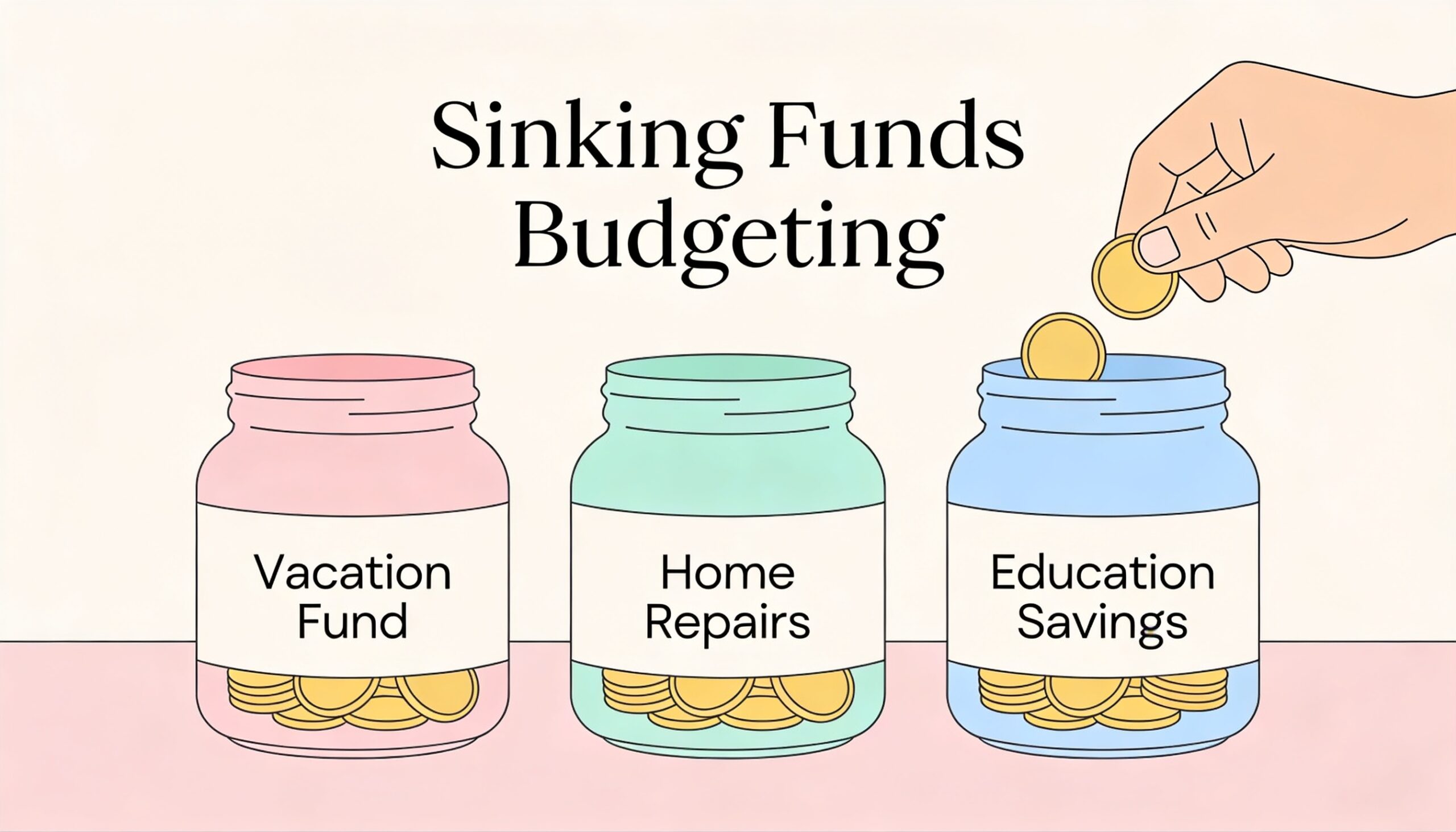
A sinking fund is money you set aside a little at a time for a planned future expense. That’s it. No fancy financial wizardry, no complicated formulas. You take a big expense, break it into smaller monthly chunks, and save for it gradually so the money is ready when you need it.
The term actually comes from the corporate finance world, where companies would set aside money over time to pay off debt or replace expensive equipment. But regular people have been doing this for ages — your grandma probably had envelopes stuffed with cash labeled “property taxes” and “new washing machine.” Same concept, just a fancier name.
Let’s say you spend about $1,200 on holiday gifts and travel every year. Instead of scrambling in November or putting it all on a credit card, you set aside $100 every month starting in January. By the time the holidays arrive, the money is sitting there waiting for you. No stress, no debt, no guilt.
That monthly $100 feels completely manageable. A surprise $1,200 bill? Not so much.
Sinking Funds vs. Emergency Funds: They’re Not the Same Thing
This is where a lot of people get confused, and I want to clear it up because understanding the difference matters.
An emergency fund is for things you genuinely can’t predict — a layoff, a medical emergency, your furnace dying in January, your car getting totaled. These are true surprises that could derail your financial life if you don’t have a cushion.
A sinking fund is for things you know are coming. Your car will need new tires eventually. Your kid will start school and need supplies. Your laptop won’t last forever. These aren’t emergencies — they’re inevitabilities.
Here’s why this distinction matters so much: if you don’t have sinking funds, you’ll keep raiding your emergency fund for things that aren’t actually emergencies. And then when a real emergency hits, you’re left exposed.
I’ve seen this pattern play out dozens of times. Someone builds up a solid emergency fund — let’s say $5,000 — and then chips away at it every time a “surprise” expense pops up. New brakes? Emergency fund. Annual subscription renewals? Emergency fund. Vet visit for the dog’s yearly checkup? Emergency fund. Before they know it, the emergency fund is down to $800 and they feel like they can never get ahead.
The fix is dead simple: give those predictable expenses their own savings buckets. Keep your emergency fund sacred for actual emergencies.
Sinking Fund Categories Worth Creating
Now, you don’t need to create 47 different sinking funds (though some people do, and more power to them). Start with the ones that hit your budget the hardest. Here are the most common categories that tend to trip people up:
The Big Ones
- Car maintenance and repairs — Oil changes, tires, brakes, inspections. Budget around $100-$200/month depending on your vehicle’s age. This one alone will save you so much stress.
- Home maintenance — A general rule of thumb is to save 1-2% of your home’s value per year. Roofs need replacing, water heaters die, stuff breaks. It’s just what houses do.
- Insurance premiums — If you pay auto, home, or life insurance annually or semi-annually, divide that total by 12 and save monthly.
- Property taxes — If yours aren’t escrowed into your mortgage payment, this is a must-have sinking fund.
- Medical and dental — Even with insurance, copays and deductibles add up. Glasses, dental work, prescriptions — budget for them.
The Lifestyle Ones
- Holidays and gifts — Christmas, birthdays, anniversaries, weddings. Add up what you spent last year and divide by 12. Done.
- Vacations — Want to take a trip without going into debt? This is how you do it.
- Clothing — Especially if you have growing kids. Seasonal wardrobes aren’t optional when your 8-year-old grows three inches every six months.
- Back to school — Supplies, fees, new shoes, backpacks. It happens every August like clockwork.
The “Future You” Ones
- Technology replacement — Your phone, laptop, and other gadgets will need replacing every few years. Save $30-$50/month and you’ll never finance a phone again.
- Furniture and appliances — That couch won’t last forever. Neither will your dishwasher.
- Car replacement — Even if it’s years away, putting aside $200/month toward your next car means a much smaller loan (or no loan at all) when the time comes.
- Pet expenses — Annual vet visits, medications, grooming, and that inevitable “the dog ate something weird” vet trip.
You might look at this list and think it’s overwhelming. Don’t try to fund all of these at once. Pick the three to five categories that cause you the most financial stress and start there. You can always add more as your budget allows.
How to Calculate Your Sinking Fund Amounts
The math here is refreshingly simple. You really only need to answer two questions:
- How much will you need?
- How many months until you need it?
Divide the first number by the second, and that’s your monthly contribution.
Let’s walk through a few examples to make this concrete:
Car insurance (paid every 6 months): Your premium is $600 every six months. That’s $600 ÷ 6 = $100/month into your car insurance sinking fund.
Holiday spending: You typically spend $1,500 during the holidays. $1,500 ÷ 12 months = $125/month. Start in January and by November you’ll have $1,375 — close enough, and you can adjust.
New laptop in 2 years: You want to spend about $1,000 on a new laptop in 24 months. $1,000 ÷ 24 = roughly $42/month.
Annual vet visit: Last year the vet cost you $450 for checkups and vaccinations. $450 ÷ 12 = $37.50/month. Round up to $40 because vet costs seem to go up every year.
For expenses where you’re not sure of the exact cost, look at what you spent last year and add 10-15% for inflation and unexpected additions. It’s better to slightly overshoot and have a little extra than to come up short.
What If You Can’t Afford All Your Sinking Funds Right Now?
Real talk — when you add up all these monthly contributions, the total might make you sweat a little. That’s normal. Here’s how to handle it:
Start with what’s most urgent. If your car insurance is due in three months, prioritize that fund. If the holidays are nine months away, you have more time.
Use minimum viable amounts. Saving $20/month toward car repairs is infinitely better than saving $0. When a $500 repair bill comes and you have $240 saved, you only need to find $260 instead of the full $500. Progress, not perfection.
Revisit and adjust quarterly. Your sinking fund amounts aren’t set in stone. Got a raise? Bump up your contributions. Going through a tight month? Scale back temporarily. The key is consistency over time, not rigid adherence to exact amounts.
Where to Keep Your Sinking Fund Money
This is a practical question that matters more than you’d think. You want your sinking fund money to be:
- Separate from your everyday checking account (so you don’t accidentally spend it)
- Easy to access when you need it (no penalties for withdrawal)
- Ideally earning at least a little interest
Here are the most popular approaches:
High-Yield Savings Accounts (HYSAs)
This is the go-to choice for most people, and for good reason. Online banks like Ally, Marcus, or Capital One 360 offer savings accounts earning 4-5% APY (as of early 2026), which is miles better than the 0.01% your local bank probably offers. Many of these banks let you create multiple savings “buckets” or sub-accounts within one account, which is perfect for organizing different sinking funds.
The money is FDIC-insured, earns decent interest, and you can transfer it to your checking account within 1-2 business days when you need it. Hard to beat that combination.
Dedicated Savings Accounts
Some people prefer opening separate savings accounts for each major sinking fund. This gives you maximum clarity — you can see at a glance exactly how much is in each bucket. Banks like Ally make this easy by letting you open multiple savings accounts with no fees or minimums.
The downside is managing multiple accounts can feel like a lot. If you have six sinking funds, that’s six accounts to track. For some people, that’s organized. For others, it’s chaos.
The Envelope System (Digital or Physical)
Old school but effective. Some people use actual cash envelopes for shorter-term sinking funds. Label each envelope, stuff in the monthly amount, done. The tactile nature of handling cash makes overspending feel more real for a lot of people.
If cash feels too old-fashioned, apps like YNAB (You Need A Budget) or Goodbudget let you create virtual envelopes. The money stays in one account, but the app tracks how much is allocated to each category. YNAB in particular was basically built around this concept.
Money Market Accounts
If your sinking funds grow large — like a car replacement fund that accumulates over several years — a money market account can offer slightly better rates than a standard savings account while still keeping your money liquid. Some even come with check-writing privileges, making it easy to pay for things directly from the fund.
Where NOT to Keep Sinking Fund Money
A few quick don’ts:
- Don’t keep it in your checking account. You’ll spend it. Trust me.
- Don’t invest it in the stock market. Sinking funds are for short to medium-term goals (under 5 years typically). You don’t want your new car fund dropping 30% because the market had a bad quarter.
- Don’t put it in a CD with early withdrawal penalties unless you’re absolutely sure you won’t need it before the CD matures.
Making Sinking Funds Actually Work: Practical Tips
Setting up sinking funds is the easy part. Sticking with them takes a little more intention. Here’s what I’ve seen work best:
Automate everything. Set up automatic transfers on payday. If the money moves before you see it in your checking account, you won’t miss it. Most banks let you schedule recurring transfers — use that feature.
Track your balances monthly. A simple spreadsheet works fine. List each sinking fund, the target amount, the current balance, and how much you’re contributing monthly. Five minutes once a month keeps you honest and motivated.
Celebrate the wins. When you pay your car insurance from your sinking fund instead of scrambling to cover it, take a second to appreciate that. You planned for this. You did the thing. That’s worth acknowledging.
Replenish after spending. Once you use a sinking fund, start refilling it immediately. If you drain your holiday fund in December, your January budget should include that monthly contribution again right away.
Review annually. At the end of each year, look at what you actually spent versus what you saved. Did you over-save in some categories and under-save in others? Adjust your monthly amounts accordingly. Your sinking funds should evolve as your life changes.
The Bigger Picture
Here’s what I love most about sinking funds: they change your relationship with money in a really fundamental way. Instead of constantly reacting to expenses — putting out fires, stressing about bills, feeling behind — you’re proactively managing your financial life. You’re making decisions in advance, calmly and rationally, instead of making them under pressure when a bill is due tomorrow.
That shift from reactive to proactive is huge. It reduces financial anxiety. It keeps you out of debt. It protects your emergency fund for actual emergencies. And honestly, it just makes you feel more in control of your life.
You don’t need to be a financial expert to make this work. You don’t need special software or a finance degree. You need a calculator, a savings account, and the willingness to spend 30 minutes mapping out your predictable expenses.
Start this week. Pick your top three categories, do the math, set up the automatic transfers, and move on with your life. Future you is going to be so grateful.